Thailand's only horse-carriage city, a UNESCO-recognised temple where three cultures share a single roof, hand-woven silk that takes a master weaver weeks to finish, and a wall painting of two lovers whispering — one of the most quietly affecting images in all of Southeast Asia.
Most travellers in northern Thailand follow the same corridor: Chiang Mai, Chiang Rai, back to Bangkok. What they miss is a road that curves east and south through three towns that have been left alone long enough to become entirely themselves. Lampang still runs horse-drawn carriages as a genuine transport option — not a heritage prop but actual working vehicles whose drivers know every backstreet. Phrae is a silk town where the weavers call certain patterns “the heart stitch” because the technique requires picking individual threads with your fingertips, one by one, for weeks. And Nan is the kind of town that confuses first-time visitors, because everything looks slightly too good to be real: the murals too vivid, the old-city streets too quiet, the light that falls on the teak shophouses in the afternoon too golden to be a coincidence.
This four-day itinerary was built for the traveller who has already done Chiang Mai and is ready for the layer underneath — the one that doesn’t show up in the standard guidebooks. We’ve chosen stops that reward slowness: a colonial restaurant where lunch is a two-hour affair, a morning market where the produce is so local that some of it doesn’t have a name in English, a textile museum that will permanently change how you look at fabric, and a temple where a camera-obscura phenomenon projects the golden chedi upside-down onto a white cloth inside the shrine room. Every stop has been chosen because you cannot rush it and come away with the same thing. That, in a northern Thailand context, is a feature not a flaw.
The itinerary
The horse-carriage city, a golden chedi, and a colonial evening
1Wat Phra That Lampang Luang2Baan Phraya Suren by Madame Musur3Lampang Horse Carriage Association — City Tour by Carriage4Wat Pongsanuk Nuea — the UNESCO Temple5Kad Kongta Walking Street
Photo not yet uploaded
Morning
Wat Phra That Lampang Luang
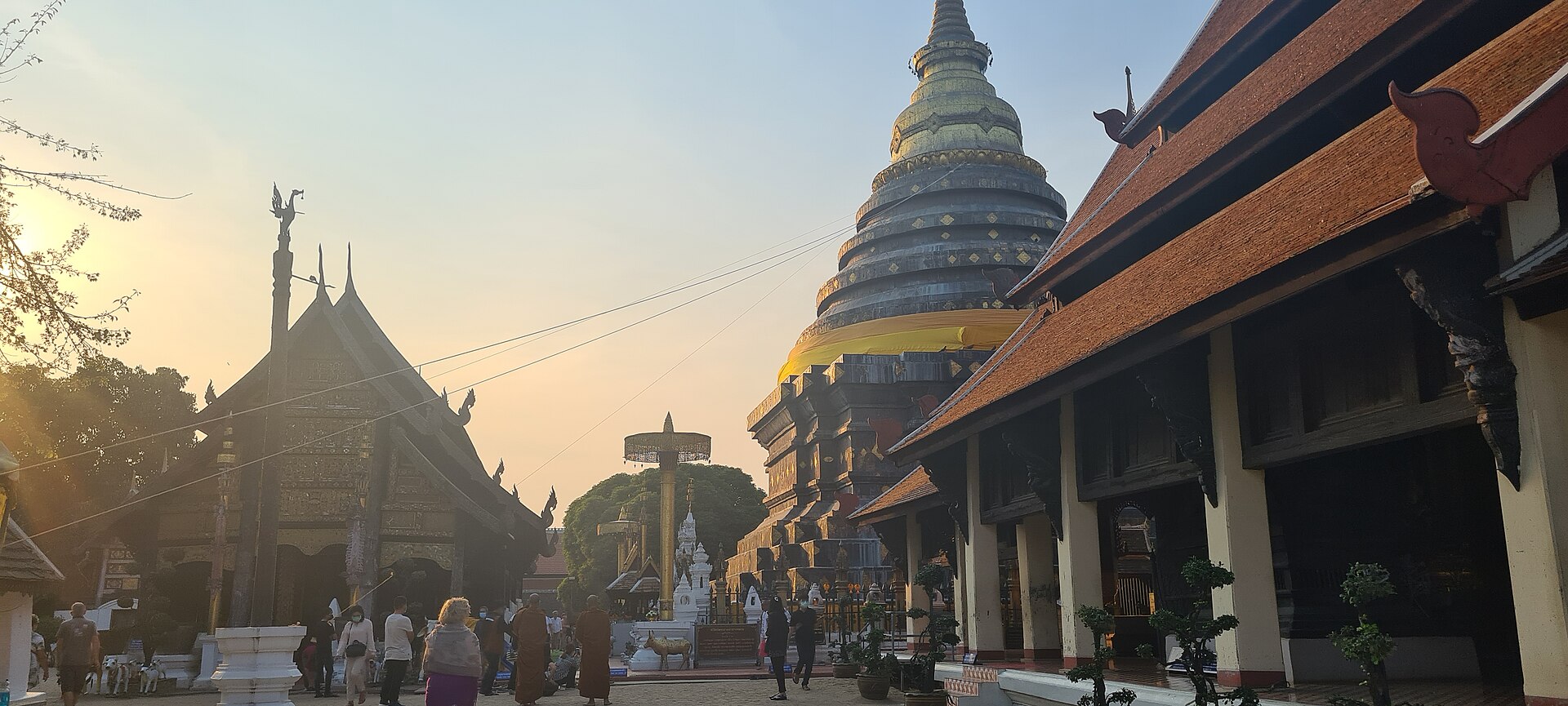
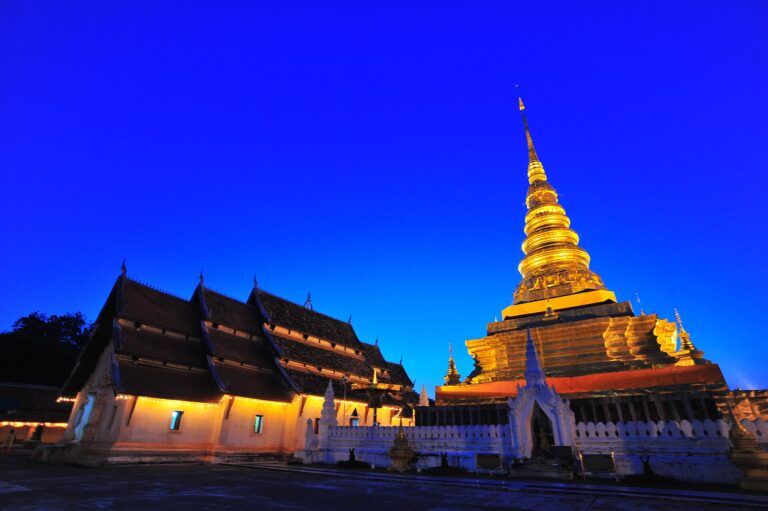
Eighteen kilometres south of Lampang town, on a low laterite mound in the district of Ko Kha, stands the oldest and most important temple in the province — and arguably one of the most architecturally complete Lanna temple complexes still intact in Thailand. The main viharn was built by local craftsmen in the fifteenth and sixteenth centuries; the carved stucco on its pediment is so sharp-edged it looks as though it was finished last week. Walk through the gate slowly. The atmosphere inside the compound is composed rather than touristic — locals come to make merit, monks move through corridors, and the scent of incense from a dozen small shrines drifts across the stone courtyard. The highlight for those who know what to look for is the Viharn Nam Taem, a small side shrine where sunlight enters through a pinhole in the wall and projects an inverted image of the golden chedi onto a white cloth — a natural camera obscura that predates the concept by centuries. Leave the car park at 08:00 and you will have the golden morning light entirely to yourself.
Insider tip: bring a small torch for the Viharn Nam Taem — the inverted projection is faint and your eyes need a moment to adjust. The guide will position the cloth for you. This is one of those things that photographs cannot do justice; just look.
Photo not yet uploaded
Late morning
Baan Phraya Suren by Madame Musur
Back in the city, lunch at Baan Phraya Suren is less a restaurant visit and more a lesson in what Lampang used to be. The building is a two-storey colonial structure built over a hundred years ago, when Lampang was the crossroads of the northern teak trade — Burmese merchants moved the logs, British firms (Borneo Company, Bombay Burmah) held the concessions, and Indian traders managed the finance. The house reflects all of that: turned wooden columns, a high-ceilinged dining room, and a garden shaded by trees that have been there longer than anyone now living can remember. The kitchen cooks northern Thai heritage recipes — hung lay pork curry slow-simmered to a deep copper colour, oam gai baan (village chicken broth with vegetables), nam prik num with seasonal greens and house-made crispy pork skin. None of it is fussy. All of it is correct. The “Madame Musur” in the name is a story in itself: ask your guide, or the staff, and see which version you get.
Photo not yet uploaded
Afternoon
Lampang Horse Carriage Association — City Tour by Carriage
Lampang is the only city in Thailand where horse-drawn carriages are still used as actual working transport, not a heritage attraction that runs for thirty minutes and deposits you where you started. The carriages are owned by families, maintained by families, and driven by men who inherited both the trade and the horses. The route takes you through the grid of old Lampang — past the Louis T. Leonowens Trading Company building (son of the Anna of Siam, who came north to trade teak), past Baan Sao Nak with its eighty-two carved teak columns and its quietly enormous rooms, and along the Mae Wang River bank where the colonial-era shophouses have been standing since the 1890s without anyone asking them to hurry up. The carriage moves at a pace that makes the city legible: you can read the inscriptions above the doors, smell the temple incense, and hear the river without straining. Sit on the left side of the bench for the best sightline onto the old-city facades.
Insider tip: ask the driver to slow down in front of Baan Sao Nak — the teak columns are best seen from the street, and pausing there for five minutes costs nothing. If you want to go inside, our guide can arrange it as a brief addition.
Photo not yet uploaded
Late afternoon
Wat Pongsanuk Nuea — the UNESCO Temple
In 2008, UNESCO awarded Wat Pongsanuk Nuea its Award of Excellence for Cultural Heritage Conservation — because this single temple, in a single compound, manages to synthesise Thai, Chinese, and Burmese architectural traditions so completely that scholars still cannot agree on which element came from where. The Viharn Phra Jao Phan Ong houses hundreds of Buddha images of varying sizes, donated by the surrounding community across many centuries, arranged so densely that the room seems to breathe. The carved wooden ceiling and the plaster bas-reliefs on the walls are in remarkably good condition, and the afternoon light through the western windows turns the whole interior into something closer to a painting than a building. The temple is still an active centre of community life — you may find monks chanting, local women arranging flowers, or elderly men sitting in the cool shade of the courtyard trees. That ordinariness is the thing that makes it extraordinary.
Photo not yet uploaded
Evening
Kad Kongta Walking Street
When the light drops and the temperature follows, the old riverside district along the Mae Wang comes to life. Kad Kongta — “the old pier street” — is lined with shophouses that are now cafes, craft stalls, and local food vendors, all operating inside buildings that look exactly as old as they are. This is not a sanitised night market engineered for Instagram; it is the neighbourhood where people live, and the vendors are largely the same families who lived here before tourism arrived. Try grilled banana bread, kao krayap pak mor (crispy Lanna rice crackers), or a glass of fresh sugarcane juice squeezed to order. Several cafes occupy century-old teak interiors lit by Edison bulbs and furnished with things the owners found in the attic rather than ordered online. Kad Kongta runs on Friday and Saturday evenings; if your itinerary falls on a weekday, our guide has alternatives in the same neighbourhood that are open nightly.
Note: the full walking street format runs Friday–Saturday evenings only. Tell us your preferred travel dates and we will position Day 1 accordingly — or suggest the equally characterful weekday alternative along the same streets.
Breakfast
Lunch
Dinner
Hotel
boutique hotel in the old-city district, within easy walking distance of Kad Kongta — colonial-era teak interiors, ten-minute walk to the horse carriage departure point.
Morning market, the heritage railway station, textile context, and a hilltop chedi
1Kad Kaw Jao Morning Market2Nakhon Lampang Railway Station3Komont Ancient Textile Museum4Wat Phra That Cho Hae5GingerBread House Gallery6Pratu Chai Evening Market
Photo not yet uploaded
Sunrise
Kad Kaw Jao Morning Market
Before the city fully wakes, Kad Kaw Jao market is already deep into its morning logic. The vendors arrive before first light — farmers from the surrounding districts carrying whatever is in season, laid out on cloth on the ground rather than in stalls: pak wan pa (forest sweet leaf), dok kae (sesbania flowers), a dozen varieties of fresh mushroom, young tamarind leaves, and seasonal vegetables that don’t have reliable English translations because they barely exist outside of northern Thailand. Walk the perimeter first to get a sense of the full range, then come back to buy. The coffee at the market is old-school Thai filtered through a cloth sock at twenty baht a glass — better, on many mornings, than anything prepared with an Italian machine and sold for five times the price in Chiang Mai. This kind of market is a form of social infrastructure: it tells you what the region grows, what the people value, and how they greet each other first thing in the morning. Give it an hour.
Photo not yet uploaded
Morning
Nakhon Lampang Railway Station
A five-minute drive from the market brings you to one of the finest surviving examples of provincial railway architecture in Thailand. The Nakhon Lampang station was built during the reign of Rama VI, when the northern line reached Lampang in 1916 — the facade is dark-red-painted teak under long curved eaves designed by German engineers to handle tropical heat and humidity while maintaining the visual language of a Bavarian station. The trains still arrive and depart on schedule; this is not a museum building. Standing on the platform as a Bangkok-to-Chiang Mai service glides in is one of those small, irreplaceable travel moments that costs nothing and generates a disproportionate feeling of having been somewhere real. The station clock, the hand-lettered destination board, and the station master’s office window — all still in use, all original. Allow thirty minutes, then move on without rushing.
Photo not yet uploaded
Late morning
Komont Ancient Textile Museum
Before arriving in Phrae — Thailand’s silk town — it is worth spending an hour here building context. The Komont Ancient Textile Museum holds one of the most serious private collections of northern Thai woven cloth in existence: pha sin (skirt cloth), pha tin jok (footer-weave), and pha lai nam lai (flowing-water pattern), each representing a distinct tradition with its own grammar of colour and motif. Lanna weavers did not simply make fabric — they encoded cosmology, social rank, and regional identity into every thread sequence, and the patterns were passed from mother to daughter with the same care as a family name. Walking through this collection before reaching the workshops in Phrae means that when you see a weaver’s hands working the loom, you already know what those movements mean. Without context, it is craft. With context, it is something closer to literature.
Photo not yet uploaded
Afternoon — now in Phrae
Wat Phra That Cho Hae
The drive from Lampang to Phrae takes ninety minutes through low hills and paddies. The first stop in Phrae is its most revered temple: Wat Phra That Cho Hae, set on a forested hillside to the east of town, wrapped in the particular hush that comes when a place has been sacred for so long that even the trees seem to have absorbed it. The chedi is the personal protector of those born in the Year of the Rabbit, and the annual festival that wraps it in coloured cloth draws pilgrims from across the north. “Cho Hae” refers to that cloth — a specific type of lustrous fabric that has been wound around the base of the pagoda each year for longer than anyone has kept written records. The forest path to the chedi keeps the temperature ten degrees cooler than the road below, and from the upper terrace you can look out over the town of Phrae and the mountains to the north that eventually become the Phrae-Nan border range you will cross tomorrow.
Walk down: take the forest path back rather than retracing your steps by the main staircase — it passes through old-growth trees that have been standing in the temple grounds for centuries and provides a quieter exit than the main gate.
Photo not yet uploaded
Late afternoon
GingerBread House Gallery
After the hilltop, a deliberate gear-change. GingerBread House Gallery occupies an old teak house in the centre of Phrae that has been turned into a cafe and gallery space with the judgment that only comes from loving old buildings rather than merely using them — the bones are original, the additions are minimal, and the smell of freshly baked gingerbread mixing with hand-pressed coffee in a room full of old wood is the sort of sensory combination that follows you home. The walls hold rotating work from Phrae-based artists, some of it figurative, some of it textile-influenced, occasionally a painter who happens to be in the building and will talk about what they are working on. Sit for an hour. Order something warm. This is what the afternoon in a slow-travel itinerary is supposed to feel like.
Photo not yet uploaded
Evening
Pratu Chai Evening Market
Dinner comes from the Pratu Chai evening market, which assembles nightly near the old city gate and serves as Phrae’s main communal dining room. The food here is Phrae-specific in ways that will not match anything you’ve eaten in Chiang Mai — gaeng khanun (young jackfruit curry simmered with pork), saai ua Phrae (a northern sausage spiced differently from the Chiang Mai version, heavier on galangal), and nam prik pa daek dong, a fermented chilli relish with pickled mustard greens that tastes exactly like it looks. The textile stalls are worth a careful look: this is where you will encounter pha sin tin jok from local weavers, and the difference between machine-made fabric and hand-worked silk is immediately apparent if you know to run a finger along the threads and feel for the irregularity that only hands can produce. Our guide will help you tell the difference.
Fabric tip: genuine hand-woven pha sin tin jok from Phrae uses natural silk thread — the weight and surface texture are distinct from polyester blends. Hold it up to the light; real silk has a warm, slightly uneven sheen. The price difference is real and justified.
Breakfast
Lunch
Dinner
Hotel
Baan Yomna heritage guesthouse or equivalent boutique property in the old city — teak-house atmosphere, within walking distance of Pratu Chai Market.
A teak palace at dawn, the mountain crossing, and a city that hides in plain sight
1Kum Vongburi — the Teak Palace2The Phrae–Nan Road via Doi Phu Kha National Park3Nan Walking Street & Baan Luang Market
Photo not yet uploaded
Morning
Kum Vongburi — the Teak Palace
The last great private teak palace in Phrae was built in the final years of the nineteenth century by the ruling family, during the period when northern Thai cities were simultaneously integrating into the Siamese kingdom and reaching their architectural peak on the money from the teak trade. Kum Vongburi is a two-storey structure built entirely from teak — not a teak-facade building but a building in which the floors, walls, ceiling, columns, staircase, and decorative fretwork are all from the same wood, hand-cut and fitted without nails in places where modern carpenters would reach immediately for a nail gun. The details are extraordinary at close range: the ventilation grates in the wall panels are carved into peacocks and mythological creatures; the balustrades on the upper storey are interlocked curves that required a kind of patience modern construction budgets do not permit. The interior functions as a small museum of the ruling family’s possessions — silverware, ceremonial dress, photographs from the late nineteenth century showing Phrae in an earlier version of itself. Walk the upper-floor balcony for the best view of the compound’s garden and the carved roofline against the morning sky.
Go up: the upper-floor balcony is open to visitors and gives you the perspective to understand the roofline's carved ridge decorations, which are only fully visible from a height. The carved panel above the entrance door is among the finest surviving examples of late Lanna decorative carving in existence.
Photo not yet uploaded
Drive
The Phrae–Nan Road via Doi Phu Kha National Park
The 120-kilometre drive from Phrae to Nan on Route 101 is one of those journeys that justifies the trip independently of everything at either end. The road climbs steadily from the Phrae basin into the Doi Phu Kha range — the highest point on the route is the Phu Kha massif at over 2,000 metres — then descends through a series of forested ridges into the Nan valley. Along the upper section, small villages of Hmong and Lua communities appear at the roadside; some of the women still wear traditional dress as everyday clothing rather than for ceremony. In February and March, Chom Phu Phu Kha trees (Bretschneidera sinensis) bloom along the high ridgelines in clusters of pale pink blossoms — a species that grows nowhere in Thailand except this mountain range. Even outside the flowering season, the views from the high points across multiple ranges of blue-green mountains are the kind of visual scale that recalibrates something in how you understand the north of this country. Stop twice: once at the summit area for fresh air and a photograph, and once at a village roadside stall for whatever is being sold that morning.
Photo not yet uploaded
Evening — now in Nan
Nan Walking Street & Baan Luang Market
Nan is the kind of town that bewilders travellers who arrive expecting it to be like everywhere else. The old city is compact, intact, and seemingly unaware of the urgency that governs larger cities — people walk or cycle, shopfronts close at reasonable hours, and the evening light on the pale plaster walls of the old district has the quality of light in a painting rather than a place. The Nan Walking Street runs on weekends along the old streets near the museum; Baan Luang Market runs more frequently and serves as the neighbourhood’s actual dinner table. The food here is another dialect of northern Thai cooking: gaeng kae (a brothy multi-vegetable curry unique to Nan), khao soi in the Nan style (drier and spicier than the Chiang Mai version), and grilled river fish from the Nan River served with sticky rice and nam jim jaew. If you see a vendor selling grilled honey-glazed corn from a local variety, stop. It tastes like proof that the Nan valley soil is different from everywhere else.
Wander slowly: Nan's character reveals itself in the small details — the painted eaves on old shophouses, the handwritten signs above family-run noodle shops, the temple compound visible at the end of every residential lane. This is a city built at human scale, and it rewards the pace of a person on foot.
Breakfast
Lunch
Dinner
Hotel
Nan Boutique Hotel or Na Pua Resort — old-city location, views of the surrounding mountains or the Nan River, within walking distance of Wat Phumin.
The whispered mural, the elephant chedi, the black ivory, and the road home
1Wat Phumin — the most famous mural in Lanna2Wat Chang Kham Worawihan — the Elephant Chedi3Nan National Museum — the Black Ivory4Nan Specialty Shopping5Departure from Nan
Photo not yet uploaded
Early morning
Wat Phumin — the most famous mural in Lanna
Wat Phumin was built in 1596 in a form unique in Thai Buddhist architecture: the ubosot sits on a raised platform with four entrance doors facing the cardinal directions, approached by staircases flanked by great serpentine naga bodies descending from the roof’s edge as though the building itself is resting on their coils. This structure alone would make Wat Phumin worth visiting. But the reason people come from across Thailand — and increasingly from across the world — is for the murals that cover all four interior walls of the ubosot, painted in the late nineteenth century by an artist known only as Thit Buaphan. On the north wall, two figures face each other: a young man whispering something to a young woman. The couple are dressed in local Nan clothing; the woman’s expression is poised between amusement and something deeper. This image, called “Pu Man Ya Man,” has been reproduced ten thousand times on postcards and canvases and silk scarves — and still the original, seen in the dim interior of a 400-year-old temple at eight in the morning when the first light enters from the eastern door, is nothing like a reproduction. Come before the tour groups arrive, stand quietly, and give the image the attention it earned across three centuries of survival.
Early is essential: the ubosot fills with tour groups from 09:30 onward. Arrive by 08:00 and you may have the mural room nearly to yourself. Photography is permitted without flash — switch off your camera's shutter sound as a gesture of respect for the space.
Photo not yet uploaded
Morning
Wat Chang Kham Worawihan — the Elephant Chedi
A three-minute walk from Wat Phumin brings you to Wat Chang Kham, where a tall Lanna-Sukhothai style chedi is supported around its base by a ring of sculpted elephant figures — each slightly different, as though the craftsmen who shaped them were working from memory of real animals rather than a template. The style of the chedi — tall, tapered, with a lotus-bud finial — reflects the cultural connections between Lan Na and the Sukhothai kingdoms to the south, a relationship that was sometimes political alliance and sometimes antagonism, and always deeply intertwined artistically. Inside the viharn, gold Buddha images of exceptional quality sit in the low morning light that enters from the doorway. Wat Chang Kham receives far fewer visitors than its neighbour Wat Phumin, which means the atmosphere here is closer to a working temple than a cultural destination — monks chant, local worshippers bring garlands, and the incense smoke moves through the air without hurry.
Photo not yet uploaded
Late morning
Nan National Museum — the Black Ivory
The Nan National Museum occupies the former residence of the ruling prince of Nan — a late Rama V-period building that combines Thai and European architectural elements in the way that was fashionable for provincial rulers who wanted to signal both local identity and modernity. The collection covers Nan’s history from prehistoric settlement through the Lanna period to the present, with particular depth in the sections on Nan silverwork, traditional textiles, and historical weapons. The centrepiece of the collection is the Nga Chang Dam — the Black Ivory. This is a single elephant tusk of unusual dark brown-black colouring, believed to have been a ceremonial gift to the rulers of Nan several centuries ago, and now serving as the city’s most significant symbolic object. The museum is closed on Mondays and Tuesdays; we build the itinerary around this. The upper floor of the building — the former private quarters of the ruling family — has been preserved with original furniture and photographs, and gives a clear picture of life in a northern Thai royal household in the final decades of the nineteenth century.
Photo not yet uploaded
Midday
Nan Specialty Shopping
Before the journey home, allow an hour for shopping with a specific purpose. Nan produces a range of things that are genuinely difficult to find elsewhere: hand-woven cloth from Lua, Hmong, and Thai Lue communities, each with distinct pattern systems that our guide can decode; dried honey-glazed bananas from the local nam wa variety, which have a richer flavour than the standard dried fruit you encounter at airports; and Nan mandarin oranges (som si thong) when in season — October to January — the most celebrated citrus in Thailand, with a sweetness that tastes like the valley’s mineral-rich soil. For cloth, we recommend visiting shops that source directly from community weaving groups rather than commercial distributors, where a slightly higher price goes to the hands that made the fabric. Our guide knows which shops to trust.
Photo not yet uploaded
Afternoon
Departure from Nan
From Nan, there are two good ways home. The fastest is Nan Airport (IATA: NNT), served by Nok Air and Bangkok Airways with direct flights to Bangkok Suvarnabhumi and Don Mueang — the journey takes about an hour and twenty minutes, and your guide and driver will see you through check-in before saying goodbye. The more scenic option is the private car back to Chiang Mai, following Route 1091 through Wiang Sa and Pong — roughly three and a half to four hours, with the option to stop at a riverside viewpoint or a hill-tribe market along the way. Both options are included in our planning, and we arrange whichever fits your onward travel.
Breakfast
Lunch
Dinner
Hotel
Pricing
from $1,010 / person
Essential
$1,010
per person
Comfort
$1,300
per person
Boutique
$1,870
per person
What's Included
Included
3 nights' accommodation as described
Licensed English-speaking guide throughout
Private air-conditioned car and driver
Daily breakfast at each property
All entrance fees and listed activities
Horse carriage city tour in Lampang
Bottled water and snacks in the vehicle
Travel insurance (basic)
Airport or station pickup on Day 1
Not Included
Flights or train to Lampang / from Nan
Lunch and dinner (unless noted)
Alcohol and personal beverages
Personal shopping
Gratuities for guide and driver (at your discretion)
Make It Yours
This is a starting point — make it yours. Every We Go Round trip is private and paced to your rhythm. Popular ways people adapt this route: Arrive by overnight sleeper train from Bangkok to Lampang station — one of the great rail arrivals in Thailand Add a private weaving workshop session with a Phrae tin jok master weaver — watch a full pattern sequence built from thread, and try a row yourself Extend by two nights in Nan to cover the Nan River valley and outlying Lue weaving villages at Tha Wang Pha Combine with our 4-day Chiang Rai itinerary for a complete Far North circuit Swap the return flight for the scenic road via the Nan River gorge to Phitsanulok, heading south through a part of Thailand almost nobody drives Get my proposal — free, within 48h WhatsApp us
Frequently Asked Questions
How do I get to Lampang to start this trip?
Lampang has its own airport with daily connections from Bangkok on multiple carriers — the flight takes about an hour and twenty minutes. The most atmospheric option is the overnight sleeper train from Bangkok Hua Lamphong or Bang Sue, arriving at Lampang’s heritage teak-and-timber station early in the morning — your guide will be waiting on the platform. From Chiang Mai, Lampang is 100 kilometres south by private car (about 90 minutes), and we can include a Chiang Mai hotel pickup as the start of Day 1 without additional charge.
When is the best time to visit Lampang, Phrae, and Nan?
November to February is the prime window: temperatures between 15°C and 28°C, clear skies, and extraordinary morning light in the old cities. February and March bring the Chom Phu Phu Kha blossoms on the mountain road between Phrae and Nan — a rare pink-flowering tree found nowhere else in Thailand. April to May heats up significantly. The rainy season from June to October turns the rice paddies vivid green and reduces crowds substantially, though mountain roads require more care. The Nan Walking Street and some market events adjust seasonally — we factor this into date recommendations.
How physically demanding is this itinerary?
The pace is gentle throughout and suitable for travellers 55+. The most demanding moments are the staircase at Wat Phra That Cho Hae in Phrae (a steady climb with a handrail, manageable in ten to fifteen minutes) and the upper-floor walk at Kum Vongburi (an indoor staircase). Temple courtyards involve some walking on uneven stone surfaces. The horse carriage tour requires no physical effort at all. Our guide keeps the car close and adjusts rest stops to the group’s pace. Comfortable walking shoes with grip are the main preparation required.
How far in advance should we book?
For the November to February peak season, we recommend booking 6–8 weeks ahead — boutique properties in Phrae and Nan have limited rooms that fill well in advance, particularly around Thai public holidays and the Nan Winter Festival in December. At other times of year, two to three weeks is usually sufficient. We hold your dates with a 30% deposit, with the balance due 30 days before departure. Cancellation terms are flexible up to 21 days before travel.