Thailand's northernmost province holds a world most travellers rush past — where Yunnan families have grown award-winning oolong on high ridges since 1949, a living artist has spent decades covering an entire temple in indigo and gold, and the morning mist over the tea terraces is reason enough to stay another day.
Chiang Rai is not Chiang Mai. There are no tourist malls, no streets lined with trekking agencies, no crowds jostling for the same photograph. The province sits where Thailand, Myanmar, and Laos converge — a crossroads that has always attracted people who arrived with something worth carrying: seeds, stories, skills.
The most remarkable of these arrivals were Yunnan Chinese families who fled the civil war in 1949, crossed the mountains with tea seedlings wrapped in cloth, and planted them at 1,500 metres on Doi Mae Salong. Three generations on, their oolong is auctioned in Hong Kong and served in Kyoto. Meanwhile, in town, a self-funded artist named Chalermchai has been constructing a temple of mirror-glass and white plaster since 1997, still unfinished. His student answered with an entire temple in indigo blue across the river. History here is not behind glass — it is still being made.
This ten-day Signature Journey is designed to reveal that depth: unhurried time with the tea growers, conversations with craftspeople who rarely see visitors, and the particular silence of early mornings on a mountain where mist fills the valley and your oolong was grown fifty metres from where you're sitting. We have been building these introductions for fifteen years. What you'll find here is not available on a day tour.
The journey unfolds in four distinct phases — each with its own character, pace, and set of encounters.
Your guide meets you at Chiang Rai airport (1h20m direct from Bangkok, or we can start from Chiang Mai with a scenic mountain drive). Check in unhurried. The afternoon is yours — the town is small and walkable.
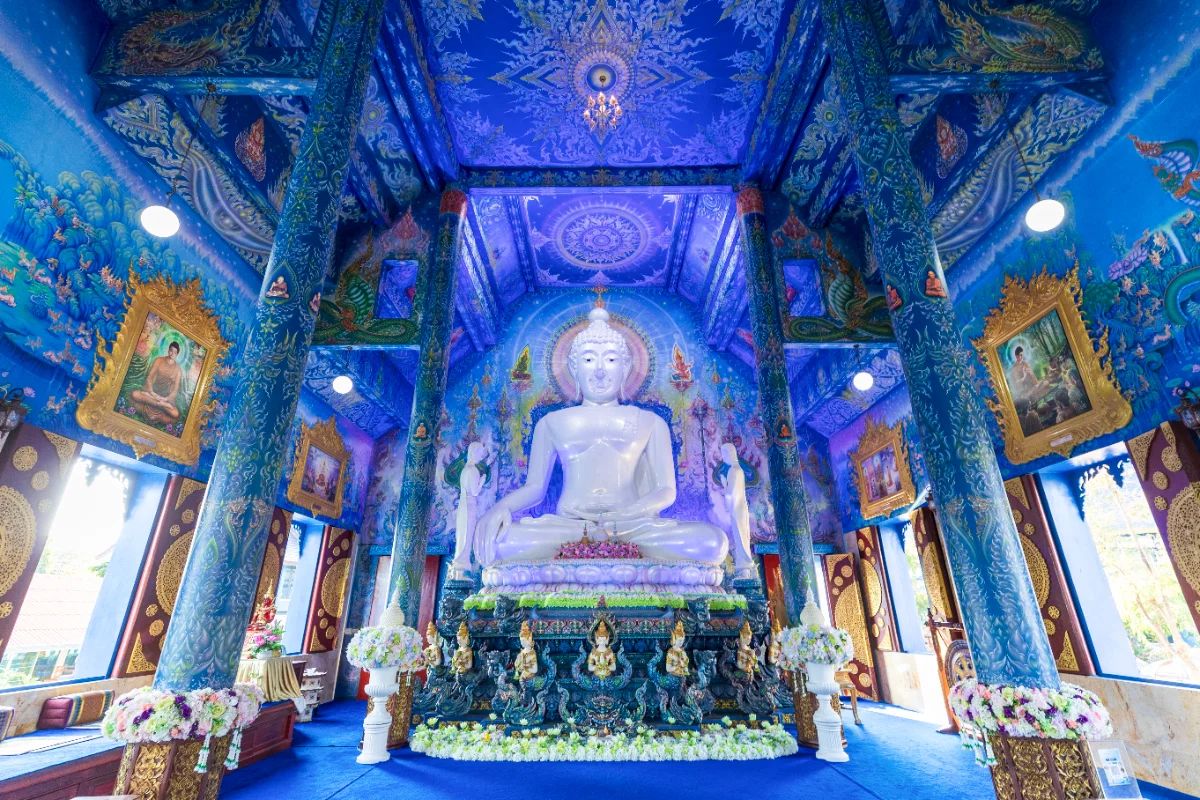
At low light, we visit Wat Rong Suea Ten — the Blue Temple. We time it for the hour before sunset when the day-trip buses have gone and the deep indigo and gold catch the slant of the late sun. This is not ancient Buddhist art: it is being built by a living craftsman, a student of the White Temple's creator. Seeing it this way changes how you understand what comes later.


A quiet table at Horizon Café above the Mae Kok River — northern Thai cooking using what was grown this week: mountain pork sausage, smoked chilli relish, river fish with galangal. A slow first evening. No agenda.
Morning — Singha Park: a working farm of 8,000 acres on the edge of town. A slow farm-tram circuit through tea fields, flower meadows, and strawberry rows, with giraffes appearing where nobody told you to expect them. The pace is deliberate. The tea you taste here was grown on the hill you can see from your cup.
Midday — Mae Fah Luang Art & Cultural Park: one of the finest collections of Lanna teak architecture and sacred objects in existence — and almost no visitors. Founded by the Queen Mother, who worked in these highland communities for decades. The quietness of the pavilions is not an accident.
Afternoon — Baan Dam (the Black House): the life's work of late National Artist Thawan Duchanee — forty black teak buildings filled with animal bones, carved wood, and Buddhist imagery refracted through a very particular philosophy. The dark counterpart to tomorrow's White Temple. Deeply strange. Entirely unforgettable.

A day with no temples and no queue. We spend the morning visiting two or three of the craft workshops that make Chiang Rai genuinely different from anywhere else in the North — a silversmith whose family has worked Akha patterns for three generations, a ceramicist who learned her firing technique from a Japanese teacher, a weaver who documents hill-tribe textile traditions before they disappear.
These are real introductions, not demonstrations. Your guide has worked with these craftspeople for years. If something catches your attention, you stay longer. If you want to try your hand, they will show you.
Afternoon is unstructured: the old town, the night market opening early, or simply the hotel garden.
A winding ninety-minute climb into a mountain town that feels closer to Yunnan than Bangkok. Chinese shophouses, steamed buns for breakfast, elderly men playing Chinese chess outside the tea trader's door. Your guide tells the story of the KMT soldiers who arrived here in 1949 — defeated by Mao, crossing Burma with families and seeds, settling at 1,500 metres because the altitude matched what they had left behind.
Three generations later their grandchildren grow the finest oolong in Southeast Asia. This is not a constructed ethnic tourism experience. It is a living community that adapted to a new country without losing itself.


Five hundred acres of sculpted tea terraces falling down the ridgeline — one of the most photographed views in the North, and deserving of the reputation. We taste estate oolongs and green teas in the hilltop pavilion while watching the pickers work the rows below. The tasting is guided: not a rushed sample stop, but a proper introduction to what altitude and varietal mean in a cup.


Tonight you stay inside a working tea estate on Doi Mae Salong. The lodge is owned by the tea family themselves. Dinner is Yunnanese: braised pork belly, mountain greens, rice wine if you want it. The valley darkens and the mist begins to rise from below.
If the season is right — and from November through February it almost always is — you will wake to a sea of cloud beneath the balcony. This is the night guests talk about for years after.
A morning with the Wang Put Tan family — the estate owner speaks good English and is genuinely happy to explain the difference between how his grandfather processed oolong in Yunnan and how the mountain here changed what was possible. He will walk you through the withering, rolling, and firing process with leaves picked that morning.
This is not a ticketed demonstration. It is a conversation between people who grow something remarkable and people curious enough to come this far to understand it.
Afternoon: the Doi Mae Salong town market, a walk along the ridge with your guide, time at your own pace.
The descent from the mountain takes us north to Chiang Saen, the ancient Lanna capital on the Mekong. The Golden Triangle viewpoint is genuinely dramatic — the point where three countries touch and the river bends wide in both directions. The story your guide tells here — about the opium trade, the hill tribes, the transformation of the region over fifty years — is not the version sold at the tourist pier.
We continue along the riverside to Chiang Khong for lunch at a quiet restaurant above the water, watching longboats cross to Laos, before returning south to a new base in town.
Chiang Rai province has the most concentrated craft tradition in Thailand — not the souvenir craft of the Chiang Mai market, but working traditions kept alive by people who depend on them. Today we visit a Karen or Akha weaving community, spending unhurried time with the women who run it and understanding both the technique and the economics: what makes a piece valuable, what happens when the next generation leaves for the city, and what is being done to keep the knowledge alive.
We also visit a ceramics studio in the countryside outside town — a small operation making hand-thrown pieces fired in a wood kiln. The work is exceptional by any standard. It is almost entirely unknown outside Chiang Rai.
We arrive at opening time, ahead of the day's first buses. Chalermchai Kositpipat's still-unfinished temple — every exterior surface covered in white plaster and mirror-glass, built entirely with private funds since 1997 — rewards an early, unhurried hour. The interior murals are extraordinary: spacecraft, superheroes, and the nuclear mushroom cloud set within traditional Buddhist cosmology. Not a provocation but a statement about what is happening right now.
Because you visited the Blue Temple on Day 1, and understood it as living art, you read this differently. That sequence was intentional.


A small craft tea house tucked in a garden near the Mae Kok River — almost impossible to find without an introduction. The owner blends single-origin teas from the mountain farms we visited on Days 4 and 5, and has won recognition from tasting panels in Japan and Europe. A two-hour session: four or five teas brewed at specific temperatures, served in hand-thrown stoneware fired in the garden. This is where the journey closes the loop.
The cups are for sale. Several guests have bought them as a way of bringing the place home.


The final full day is deliberately kept open. Some guests return to the craft studios to collect a commissioned piece. Some spend the morning at the night market (which, confusingly, starts in the afternoon) or revisit a place that stayed with them. Some simply sit at the hotel and do nothing in particular.
If you wish, we can arrange a half-day excursion to Singha Park's working farm — cycling through tea rows and flower fields at the edge of town — or a cooking session with a local family.
Evening: a farewell dinner at a restaurant your guide has chosen for the occasion. The menu is a surprise.
Private car to Chiang Rai airport for your flight home — or we continue together to Chiang Mai, to Nan, or directly into our 21-day Slow North Signature Journey. Your guide confirms all logistics the evening before, handles bags, and stays with you until the gate.
The journey ends where it makes sense for your plans. We do not leave you to navigate the last part alone.
| Package | What changes | From (pp) |
|---|---|---|
| Essential | Quality four-star stays in Chiang Rai, all touring, meals, and craft introductions as described | $4,200 |
| Comfort | Best rooms at Le Méridien, premier suites at the tea-estate lodge, private dining upgrade | $5,400 |
| Boutique | Exclusive craft sessions, private tea-master tutoring, premium restaurant selections, enhanced throughout | $7,200 |
Every We Go Round Signature Journey is private and built around your group's curiosity. These are the most popular ways guests have shaped this particular journey:
Direct flights from Bangkok (Suvarnabhumi or Don Mueang) take about 1h20m. We meet you at the airport. The journey can also begin from Chiang Mai — a scenic 3-hour drive through mountain switchbacks — at no extra cost. We handle all onward logistics from your arrival point.
November through February is the sweet spot: cool highland mornings (8–20°C on the mountain), clear skies, dry roads, and the tea harvest in full swing. December and January produce the densest morning mist over the terraces on Doi Mae Salong — the morning you wake there is the one guests describe most. The journey runs year-round; June–October is green and vivid with short afternoon showers.
Curious, experienced travellers who prefer depth over pace — typically 45 to 65, who have visited Thailand before and want to understand it more fully. The walking is gentle throughout; no strenuous days, no early forced starts. We ask only that you arrive with genuine curiosity. Groups of 4–8 travel together as a private party; we do not combine groups.
Yes, and many groups do. This journey connects naturally at the end into our 21-day Slow North Signature Journey (which begins in Chiang Mai and moves through Mae Hong Son, Pai, and the ethnic mountain communities). We can also add a Golden Triangle extension, time in Nan, or a leg into Myanmar or Laos if your group holds the appropriate visas. Tell us what you're curious about and we will design the connection.
For November–February travel, 8–10 weeks ahead — primarily to secure the tea-estate lodge on Doi Mae Salong, which is limited in capacity. For other months, 4–6 weeks is usually sufficient. We send a full, detailed proposal within 48 hours of your initial enquiry, at no cost and with no obligation.
A Signature Journey is We Go Round's flagship format: a multi-day arc with a coherent character, experiences sequenced with intention, and introductions to people we have worked with for years. The pace is unhurried by design. It is not a series of day tours assembled into a block — it is a journey built around the idea that places reveal themselves slowly, and that the conversations you don't plan are the ones you remember.
No shared buses, no combined groups, no fixed departure dates. When you travel with us, the route, the pace, and the depth of each encounter are shaped around your party. We send a full proposal — with accommodation options, day-by-day detail, and honest pricing — within 48 hours of your enquiry.
Shorter journeys that pair well with — or prepare you for — this route.